Not every crack in a Gatineau driveway gets the same treatment — and using the wrong method is almost as bad as doing nothing at all. Standard crack filler seals hairline and medium gaps quickly and affordably. Hot-rubber compound is a different material entirely, designed for wide, deep, or actively moving cracks that would chew through regular filler within a season. Knowing which is which before you book (or before you hand off the job to a contractor) makes all the difference.
Why Cracks Form in the First Place
Asphalt is a flexible material — flexible by design, because it needs to expand and contract with temperature. In Gatineau and across the Ottawa Valley, that range is brutal: summer highs regularly push 30°C, winter lows can drop below −25°C. That's a swing of more than 55 degrees, and every degree of change means the asphalt is either expanding or contracting slightly.
Over years, that movement causes surface fatigue. Add the effects of road salt — which accelerates oxidation of the bitumen binder and works its way into tiny surface pores — and you have a surface that will inevitably crack. The only question is how fast, how wide, and whether you catch the cracks before water gets in.
Gatineau's freeze-thaw cycle is the real damage multiplier. Aylmer, Hull, and Buckingham all see 40 to 60 freeze-thaw cycles per winter, depending on the year. A crack that lets in water in November becomes a crack that's been hydraulically expanded by ice by February. By spring breakup, what started as a 4mm gap can be 12mm wide and visibly deeper. That's the window where standard filler stops being enough and hot-rubber becomes the right call.
Method One: Standard Crack Filling
What it is
Standard crack filling uses a rubberised asphalt emulsion — a pourable, flexible compound that's applied cold or slightly warmed directly into the crack. It bonds to both sides of the crack wall, cures within a few hours, and stays pliable enough to move with the asphalt through normal seasonal temperature swings.
Best for
- Hairline cracks (under 3mm): the sealcoat itself bridges these during application, but we clean and pre-fill them if they're part of a larger crack pattern.
- Medium cracks (3–10mm): the primary use case. Clean the crack, apply filler, let it set, then seal over the top.
- Stable cracks that haven't grown meaningfully from one year to the next and show no displacement between the two sides.
What the prep looks like
Proper crack filling isn't just squeezing product into the gap. Before we apply anything, we blow or vacuum the crack clear of loose material, dirt, and vegetation. A crack full of sand and debris won't let the filler bond properly to the asphalt walls — it'll just sit on top of contamination and fail within a season. Clean crack walls are the difference between a repair that lasts three years and one that pops out in the first winter.
Method Two: Hot-Rubber Crack Repair
What it is
Hot-rubber compound — sometimes called hot-pour crack sealant — is a polymer-modified bitumen material that is heated to application temperature (typically 180–200°C) and poured directly into the crack. At that temperature it's fully liquid, flows into every void and irregular crack edge, and bonds tenaciously to the asphalt on both sides as it cools. The resulting repair is significantly more flexible and durable than cold-applied filler, and it won't go brittle in a Gatineau January.
Best for
- Wide cracks (over 10mm): cold filler applied to a wide crack shrinks as it dries, leaving a gap at the surface. Hot rubber fills and bonds completely.
- Deep cracks: where the damage extends well below the surface layer, hot rubber's liquid state lets it penetrate and seal the full depth of the crack.
- Cracks with displacement: where one side of the crack sits slightly higher or lower than the other, indicating movement in the base. Hot rubber bridges the irregularity cleanly.
- High-freeze-thaw-exposure areas: driveways in Buckingham or on north-facing slopes that stay icy longer get extra thermal stress. Hot rubber holds up better in those conditions.
Why Repair Has to Come Before Sealing
Sealcoat is a surface treatment — it protects the asphalt it touches, but it cannot bridge a gap or hold cracked sections together. Applying sealcoat over an unfilled crack just paints over the problem: the sealcoat cracks at the same spot within weeks, and water is still getting through to the base.
The correct sequence is always: clean → repair → seal. Skip the middle step and the seal won't last. This is why Drivewave treats crack filling and hot-rubber repair as part of every sealing job, not as separate services you have to remember to add.
When Repair Is Enough — and When It Isn't
Crack filling and hot-rubber repair are designed for a driveway where the structural base is sound. If the damage is limited to the top layer of asphalt — cracks, surface oxidation, minor ravelling at the edges — repair plus sealing is typically the right call, and it's a fraction of the cost of repaving.
There are situations, though, where repair alone won't hold:
- Alligator cracking (a network of interconnected cracks resembling scales) across large areas of the surface — this pattern indicates base failure, not just surface wear.
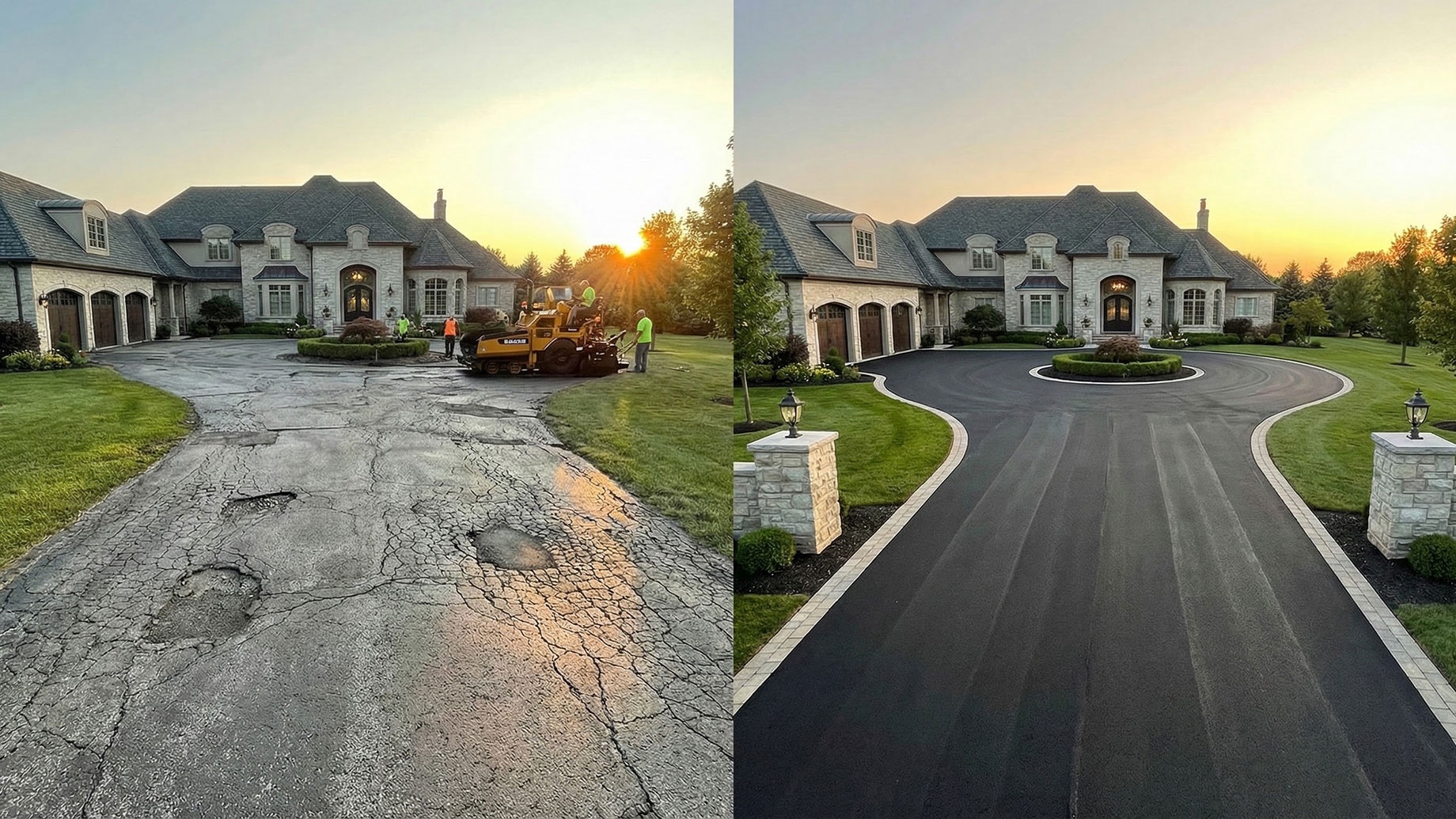
- Potholes or areas where the asphalt has broken through to the gravel base — these require patching or partial repaving before crack filling makes sense.
- Significant heaving or settling where sections of the driveway have shifted vertically — usually a sign that frost heave has disrupted the base, which no surface repair can fix.
If your driveway has any of these conditions, we'll tell you at the free on-site quote — honestly, without pressure. Sometimes the right answer is to reseal what's salvageable and plan for a partial repave of the affected section. We'd rather give you a clear picture upfront than take your money for a repair that won't last.
How Drivewave Handles Repair — One Price, Everything Included
We price by driveway size — roughly $0.70 per square foot, with a $200 minimum. That price covers the full scope: pressure washing, oil stain treatment, standard crack filling, hot-rubber repair where needed, and sealcoat application. No per-service menu, no line items for "hot rubber upgrade."
| Driveway size | Typical sq. footage | Approximate price |
|---|---|---|
| 1-car driveway | 200–350 sq ft | ~$200–$245 |
| 2-car driveway | 400–650 sq ft | ~$280–$455 |
| 3-car driveway | 700–900 sq ft | ~$490–$630 |
| Large / custom | 1,000+ sq ft | Custom quote |
Most residential driveways in Hull, Aylmer, and Gatineau sector are done in a single visit. Use the instant estimate tool for a quick ballpark, or book a free on-site quote and we'll walk the driveway with you, identify every crack, explain what we'll do, and give you a firm price before we start.