Every spring, Ottawa homeowners look at their driveway and think the same thing: is this fixable, or do I need a whole new one? It's an important question — the answer separates a few hundred dollars of maintenance from a bill in the thousands. This guide will help you read your driveway honestly, understand what the warning signs actually mean, and make the decision with clear eyes.
The short answer for most Ottawa driveways: you probably don't need to repave. But let's walk through how to know for certain.
Why Ottawa Driveways Take Such a Beating
Before diagnosing your driveway, it helps to understand why Ottawa asphalt deteriorates the way it does. Two forces do most of the damage:
Freeze-thaw cycling. Ottawa logs roughly 40–55 freeze-thaw cycles per winter — days where temperatures cross 0°C more than once. Each cycle forces water that has seeped into a crack to expand by roughly 9% as it freezes, acting like a hydraulic jack from the inside. Surface cracks become structural cracks. Structural cracks become potholes.
Road salt. The City of Ottawa applies road salt aggressively from November through March. That salt runs off into your driveway, accelerates the breakdown of the bitumen binder that holds asphalt together, and draws moisture into pores and cracks. A driveway near the street gets a disproportionate dose of it every time a plough passes.
Together, these two forces mean an unsealed, unmaintained Ottawa driveway ages faster than one in a milder climate. The good news: they're both manageable with regular maintenance. The bad news: neglect compounds quickly.
Surface Damage vs. Structural Damage — The Core Distinction
When evaluating your driveway, everything comes down to one question: is this a surface problem or a structural problem?
Surface problems — maintenance is the right answer
These are signs of a driveway that still has good bones underneath. The asphalt base is solid; the issue is at or near the top. Maintenance — crack filling, patching, and sealing — will extend the life of the driveway significantly and cost a fraction of repaving.
- Fading and greyness. Fresh asphalt is deep black. UV oxidation and salt exposure turn it grey over time. This is cosmetic and completely reversible with a sealcoat.
- Hairline and surface cracks. Narrow cracks (under 3mm wide) that don't go deep are a normal sign of age and thermal movement. They fill cleanly with crack filler or sealcoat.
- Moderate cracks (3–10mm). Still repairable with rubberised crack filler before sealing. The key is catching them before winter forces them wider.
- Isolated small potholes. A single pothole in an otherwise sound driveway can be patched cleanly. It won't be invisible, but it'll be stable and waterproof.
- Edge crumbling. The perimeter of a driveway takes extra stress from vehicles driving over the edge. Minor edge crumbling without base failure is repairable.
Structural problems — repaving may be the honest answer
These are signs that the base layer — the compacted gravel and subgrade that supports the asphalt — has been compromised. No amount of surface sealing fixes a failed base. A seal over structural damage is like painting over rot: it looks better briefly and then fails faster.
- Alligator cracking (fatigue cracking). This is the definitive red flag — a network of interconnected cracks that looks like reptile scales. It means the base layer has failed and the asphalt is flexing under load. Sealing alligator cracking is a waste of money.
- Widespread potholes. Multiple potholes across the driveway surface — not just one or two isolated spots — indicate systemic base failure rather than isolated wear.
- Heaving and unevenness. If sections of the driveway have shifted vertically — particularly near the garage apron or where tree roots run underneath — the substrate has moved. Repaving (and often regrading) is needed.
- Pooling water. Standing water after rain that doesn't drain suggests the driveway has settled unevenly or the surface has deteriorated to the point where it no longer sheds water properly.
- Crumbling at depth. If you can pull chunks of asphalt out by hand and the material underneath is loose and granular, the driveway has deteriorated past the point of repair.
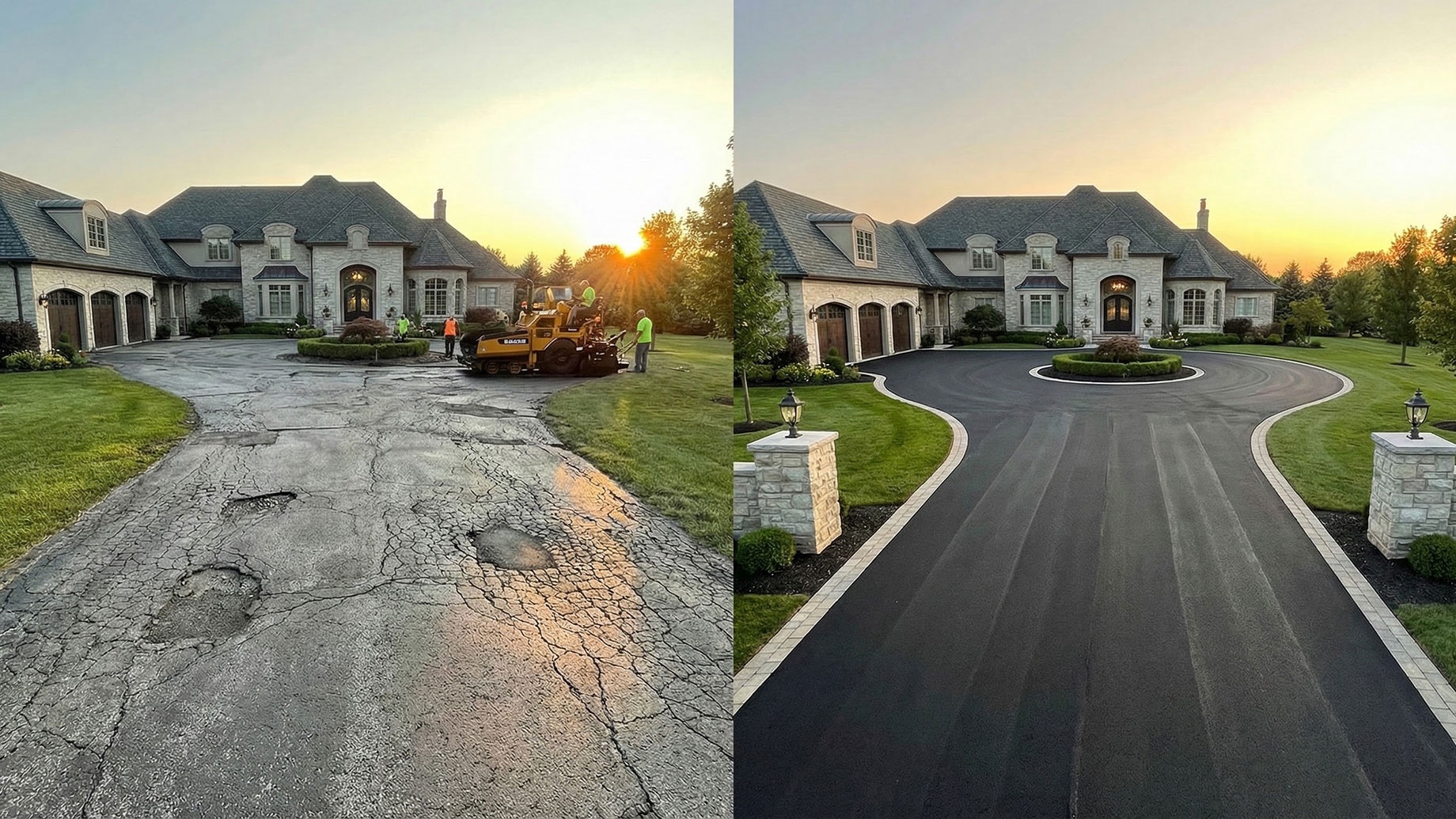
The Cost Reality: Maintenance vs. Repaving
This is where the decision often becomes straightforward. The numbers in the Ottawa–Gatineau market are stark:
| Option | What it covers | Typical Ottawa cost |
|---|---|---|
| Maintenance (seal + crack repair) | Surface cracks, fading, isolated damage — driveway with solid base | $200–$700+ |
| Partial repaving (overlay) | New layer of asphalt over sound existing base | $2,000–$4,000 |
| Full repave (tear-out and replace) | Complete removal and reinstallation — failed base | $4,500–$12,000+ |
For a standard two-car Ottawa driveway (roughly 400–650 sq ft), Drivewave's maintenance service runs approximately $0.70 per square foot — everything included (pressure washing, crack filling, oil treatment, sealcoat). That's a $280–$455 job for a driveway that repaving would cost fifteen to thirty times more to replace.
Done every two to three years, that kind of maintenance genuinely pushes full repaving 10–15 years into the future on a driveway with a sound base. The maths strongly favour maintenance for any driveway that qualifies.
Why Most Ottawa Driveways Just Need Maintenance
The majority of homeowners who call us genuinely expecting to hear they need a new driveway leave the conversation knowing they don't. Here's why:
Most Ottawa driveways were properly installed with a substantial gravel base — the region's building standards and the climate demands it. That base, once compacted correctly, doesn't just fail on its own. What fails first is the surface layer: the asphalt oxidises, hairline cracks let in water, salt accelerates the binder breakdown, and what was a minor issue two seasons ago looks alarming by spring.
Surface deterioration looks dramatic but is usually entirely manageable. Alligator cracking — the true sign of base failure — is actually less common than it appears. Many driveways we assess that look like candidates for alligator cracking turn out to have isolated patches over a still-solid base, where a prior crack was left unsealed and expanded through freeze-thaw. Patching that section and sealing the whole surface is the right call.
What Drivewave's Free On-Site Assessment Covers
When you book a free quote, here's what we actually do when we arrive:
- Measure the driveway so your price is exact — not a guess based on a photo.
- Walk and assess the surface — distinguishing surface cracks from structural cracks, checking for base softness, identifying any sections that need more than a standard fill.
- Give you a straight answer — seal and repair, or repave. If it's the latter, we'll say so clearly and explain why, at no charge and with no sales pressure.
- Give you a fixed price — not a range, not a quote that grows on the day. What we say is what you pay.
- Schedule the work. For most Ottawa driveways that qualify for maintenance, we can get on the schedule within one to two weeks — and most jobs are done the same day we arrive to work.
There's no minimum quote fee, no commitment to book, and no follow-up pressure if you decide to wait. Use the instant estimate tool for a quick ballpark, or just call us at (438) 763-7532 if you'd rather talk it through first.