If you've just had your Ottawa driveway sealed — or you're wondering whether it's time again — the most common question we hear is: how long is this actually going to last? The honest answer is 2–3 years for most Ottawa driveways, but several factors can push that number shorter or longer. Here's what actually determines sealcoat lifespan, how to tell when yours is wearing out, and why the prep work before the first squeegee stroke matters more than anything else.
The Baseline: 2–3 Years in Ottawa's Climate
A properly applied commercial-grade sealcoat on a well-prepared Ottawa driveway will typically hold for 2–3 years. That window accounts for our region's freeze-thaw cycles, summer UV load, and the road salt that gets tracked in every winter.
That said, "2–3 years" is an average — not a guarantee. A lightly used single-car driveway with excellent drainage and a quality prep job can push closer to three. A wide two-car driveway that sees daily traffic, full southern sun exposure, and heavy salt accumulation near the garage apron may start showing wear after two. Understanding what's working for or against your driveway lets you plan accordingly rather than guessing.
What Shortens (or Extends) a Sealcoat's Life
Traffic volume and vehicle weight
Every vehicle that rolls over a sealed driveway puts mechanical stress on the coating. A single-car household with one daily driver is going to see noticeably less wear than a home with three vehicles, frequent deliveries, or the occasional pickup truck parked in the same spot. High-traffic areas — the two wheel-track strips and the apron near the garage — always wear first. That's completely normal, and it's why we always apply a heavier pass to those zones.
Sun and UV exposure
UV radiation breaks down the bitumen binder in asphalt and degrades the polymers in sealcoat. A south- or west-facing Ottawa driveway that bakes in afternoon sun from May through September is going to grey and oxidise faster than one shaded by a mature tree or a north-facing house wall. If your driveway gets full sun all day, lean toward the shorter end of the maintenance window — plan to re-seal every two years rather than every three.
Drainage and standing water
Ottawa receives an average of roughly 900mm of precipitation annually, and a meaningful chunk of that arrives as snowmelt in March and April. If your driveway is level or has a slight reverse pitch toward the garage, water pools on the surface rather than running off. Pooled water accelerates sealer breakdown and, more critically, sits in any micro-cracks long enough to freeze. Good drainage is the single best passive protector of your driveway's lifespan.
Road salt
The City of Ottawa uses approximately 25,000 tonnes of road salt each winter on its roads. That salt gets tracked from the street onto your driveway every time a vehicle pulls in. Salt is hygroscopic — it draws moisture out of the air and holds it against the asphalt surface. It also lowers the freezing point of water, which sounds helpful until you realise it means water stays liquid longer and penetrates deeper before it freezes. A properly applied sealcoat creates a barrier against salt absorption; a worn or absent seal leaves the asphalt directly exposed.
Winter severity
Ottawa averages roughly 35–50 freeze-thaw cycles per winter — days where the temperature crosses 0°C at least once. In a mild winter, that number can drop. In a harsh one (like early 2024 when temperatures swung dramatically through January) it can climb higher. More cycles mean more expansion-contraction stress on both the asphalt and any sealcoat over it. There's nothing you can do about the weather, but keeping your seal in good shape going into November gives it the best chance of holding through whatever winter delivers.
Prep quality before application
This one is entirely within your control — or more precisely, within your contractor's control. A sealcoat applied to a dirty, oil-contaminated, or cracked surface will peel, bubble, and fail early. A sealcoat applied to a pressure-washed, oil-treated, crack-filled surface can achieve its full potential lifespan. The product itself is almost the easy part. Everything that happens before it matters more.
Signs It's Time to Re-Seal Your Ottawa Driveway
You don't need to track the date of your last seal job on a calendar. Your driveway will tell you when it's ready — if you know what to look for. Here are the clear signals:
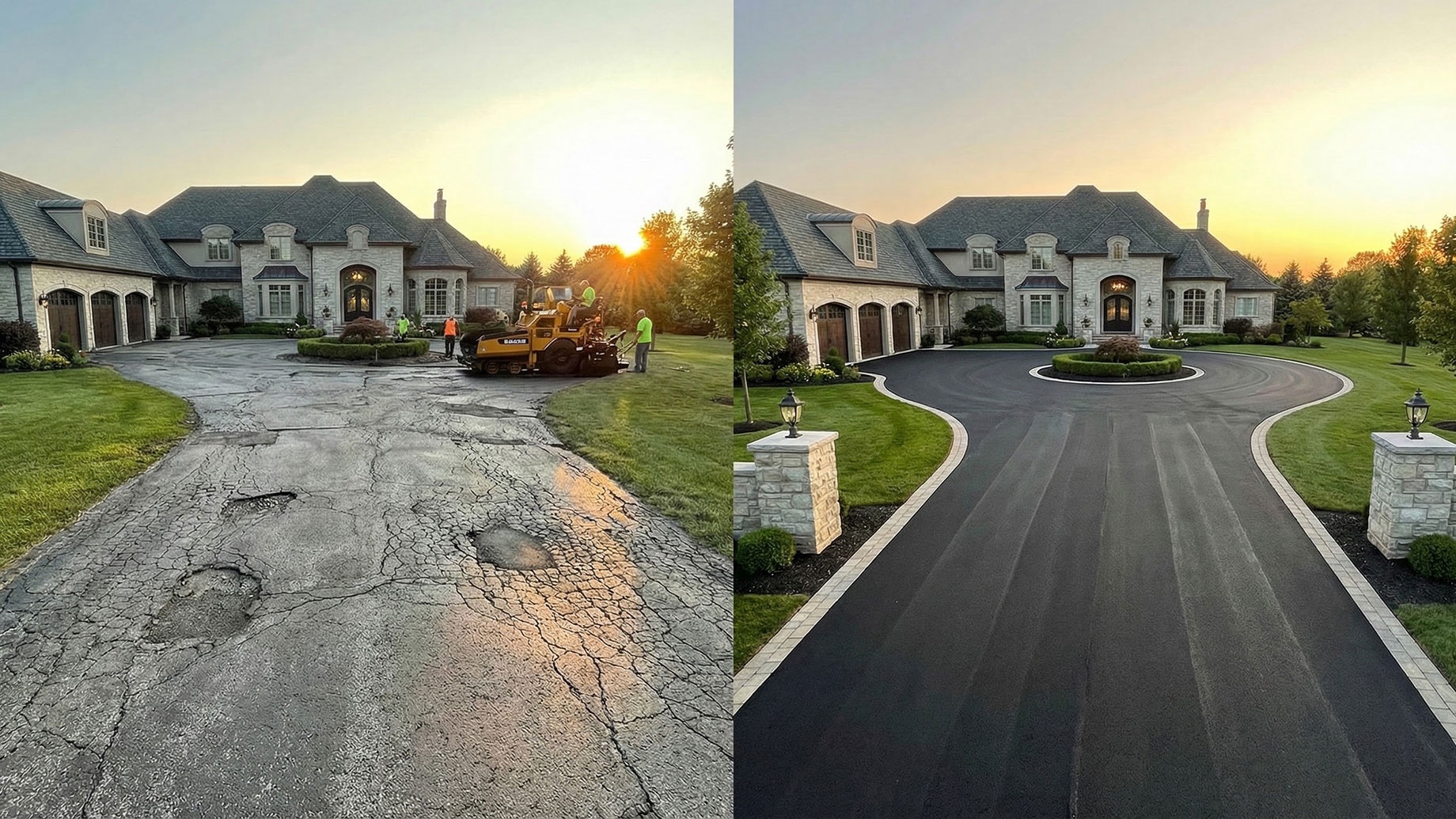
- Greying or fading colour. A sealed driveway is deep, uniform black. As the sealer breaks down, the underlying asphalt oxidises and the surface turns progressively lighter grey. When it looks more grey than black, the protective layer is thin and you're running on borrowed time.
- Water soaking in instead of beading. Run a garden hose on your driveway. If the water beads up and rolls off, the seal is intact. If it soaks straight into the surface with no beading at all, the waterproof barrier is gone and your asphalt is absorbing everything that lands on it.
- Hairline cracks appearing. Small surface cracks — thin lines that weren't there the season before — mean the asphalt is beginning to oxidise and become brittle. At this stage the situation is still entirely manageable: fill the cracks, seal the surface, and you've bought several more years. Left alone through another Ottawa winter, those hairline cracks widen.
- Visible aggregate coming loose. If you can see individual stones starting to loosen or the surface feels rough and gritty underfoot where it used to be smooth, the binder holding the aggregate together is failing. Sealing at this stage helps, but the surface is more compromised than it appears from a distance.
- Worn patches near the garage apron or wheel tracks. Localised wear in high-traffic zones is the first place sealer gives out. If those two strips look noticeably greyer or more worn than the rest of the driveway, a full re-seal is due — not just spot treatment.
The Recommended Maintenance Cadence
For most Ottawa homeowners on a standard residential driveway, the right schedule looks like this:
- New driveway: wait 12–18 months before first seal. The asphalt needs time to off-gas and fully cure. Sealing too early can trap oils and prevent proper curing.
- Light-use driveway, good drainage, partial shade: every 3 years is a reasonable target. Use the hose test each spring to confirm the seal is still doing its job.
- Average residential driveway: every 2–3 years. When in doubt, inspect in spring after the last snowmelt and again in September before the first frost.
- Heavy traffic, full southern exposure, or near-street salt zone: every 2 years. Don't stretch it to three — the wear compounds faster than it looks from season to season.
Why Prep Makes the Seal Last Longer
The most common reason a sealcoat fails early has nothing to do with the product — it's the surface it was applied to. Oil contamination stops sealer from bonding and causes bubbling and peeling within a season. Cracks that weren't filled let water in under the new coat, which freezes and lifts the sealer from below. A surface that wasn't pressure-washed still has a layer of road dust, biological growth, and salt residue between the asphalt and the new coat — adhesion is compromised from the start.
At Drivewave, the prep isn't a line item you can opt out of to save money — it's built into every single job, at a flat rate of roughly $0.70 per square foot with a $200 minimum. That includes pressure washing the full surface, treating any oil or rust stains, filling all cracks (hairline through structural), and then applying commercial-grade sealcoat at the correct spread rate. There's no per-service add-on menu and no surprises when the invoice arrives.
The reason we insist on doing it this way is simple: a seal job done right lasts. A seal job done fast and cheap looks good for one season and has to be redone — which means the customer pays twice. We'd rather do it properly once and have you call us again in three years because the schedule says so, not because something failed.
Most Ottawa driveways are completed in a single visit. You walk on it the same evening and park on it the following morning. See our pricing page for a quick estimate by driveway size, or book a free on-site quote and we'll give you an exact number after we measure.