Every spring, homeowners across Gatineau and Ottawa step outside and notice it: cracks that weren't there last October, edges that have crumbled away, a pothole forming near the garage door. The culprit is almost always the same thing — freeze-thaw cycles. Understanding exactly how they work is the first step to stopping the damage before your driveway repair bill climbs into the thousands.
The Freeze-Thaw Cycle Explained Simply
Asphalt is a porous material. Even a surface in good condition has tiny pores that hold moisture. Any crack or void — even a hairline one invisible from the street — collects water after rain or snowmelt.
Here is what happens next:
- Water enters. Rain, snowmelt, and morning dew seep into the surface pores and any existing cracks — even gaps too narrow to see clearly.
- Water freezes. Temperatures drop below zero overnight. The water inside the crack turns to ice.
- Ice expands roughly 9%. Water is one of the few substances that expands as it freezes. That 9% expansion acts like a tiny hydraulic jack pushing outward against both crack walls from the inside.
- The crack widens. When the ice thaws, the crack is measurably wider than before — and can now hold more water for the next freeze.
- The cycle repeats. This does not happen once. In the National Capital Region, it happens dozens of times every single winter — each repetition widening the crack a little more.
Why the National Capital Region Is Especially Brutal
Not all Canadian cities suffer equally from freeze-thaw damage. The worst case for asphalt is not extreme cold — it's frequent crossing of the 0°C threshold. A city that stays at -25°C all winter does less freeze-thaw damage than one that bounces above and below zero every few days.
Gatineau and Ottawa sit squarely in the worst category. Environment Canada data puts the region at 40–60 freeze-thaw cycles per winter, depending on the year. That means 40 to 60 separate events where water in your driveway's cracks freezes, expands, and thaws again. Add two compounding factors unique to this area:
Road salt
The City of Gatineau and the City of Ottawa both rely heavily on road salt (sodium chloride) to manage icy roads. Salt lowers the freezing point of water, which is exactly what you want on a public street — but on your driveway, the effect is more complicated. Saltwater that seeps into cracks refreezes at a slightly lower temperature than pure water, extending the window during which freeze-thaw cycling can occur. Repeated salt exposure also accelerates the oxidation of the bitumen binder in asphalt, making the surface more brittle over time.
Snow plows and snowblowers
Every time a plow blade or snowblower auger scrapes across your driveway, it can nick the surface and dislodge loosened aggregate from areas that are already weakened. Those small gouges become entry points for water. Plowing is unavoidable — but a well-sealed surface resists this mechanical wear far better than bare, oxidised asphalt.
The Visible Progression: From Hairline to Pothole
Freeze-thaw damage does not announce itself all at once. It follows a predictable progression that most homeowners only notice partway through — by which point repairs are more involved and more expensive.
Stage 1: Hairline cracking
Fine surface cracks, often in a pattern that follows the asphalt's natural shrinkage lines. At this stage, sealcoating alone is sufficient — the sealer bridges and fills hairline cracks as part of the application. Cost to address: the standard sealing price.
Stage 2: Moderate cracking
Cracks have widened to 3–10 mm and may have started connecting into longer lines across the surface. Water pools in them visibly after rain. This stage requires crack filling before sealing — a rubberised filler is worked into each crack, allowed to cure, and then sealcoat goes on top. Still very manageable and included in a standard Drivewave job.
Stage 3: Wide cracking and spalling
Cracks exceed 10 mm, edges begin to crumble, and chunks of asphalt are breaking away from crack margins. You may also see the classic "alligator" pattern — interconnected cracking that resembles reptile scales — which signals base saturation beginning beneath the surface. Hot-rubber repair compound is needed here, and cost begins to climb.
Stage 4: Pothole formation and base failure
Water has reached the gravel sub-base. Freeze-thaw action in the base layer causes the asphalt above it to sink, crack, and cave. At this point, patching alone will not hold long-term. Full-depth repairs or repaving sections of the driveway become necessary — and repaving a standard residential driveway in the Ottawa–Gatineau area typically runs $4,000–$10,000+.
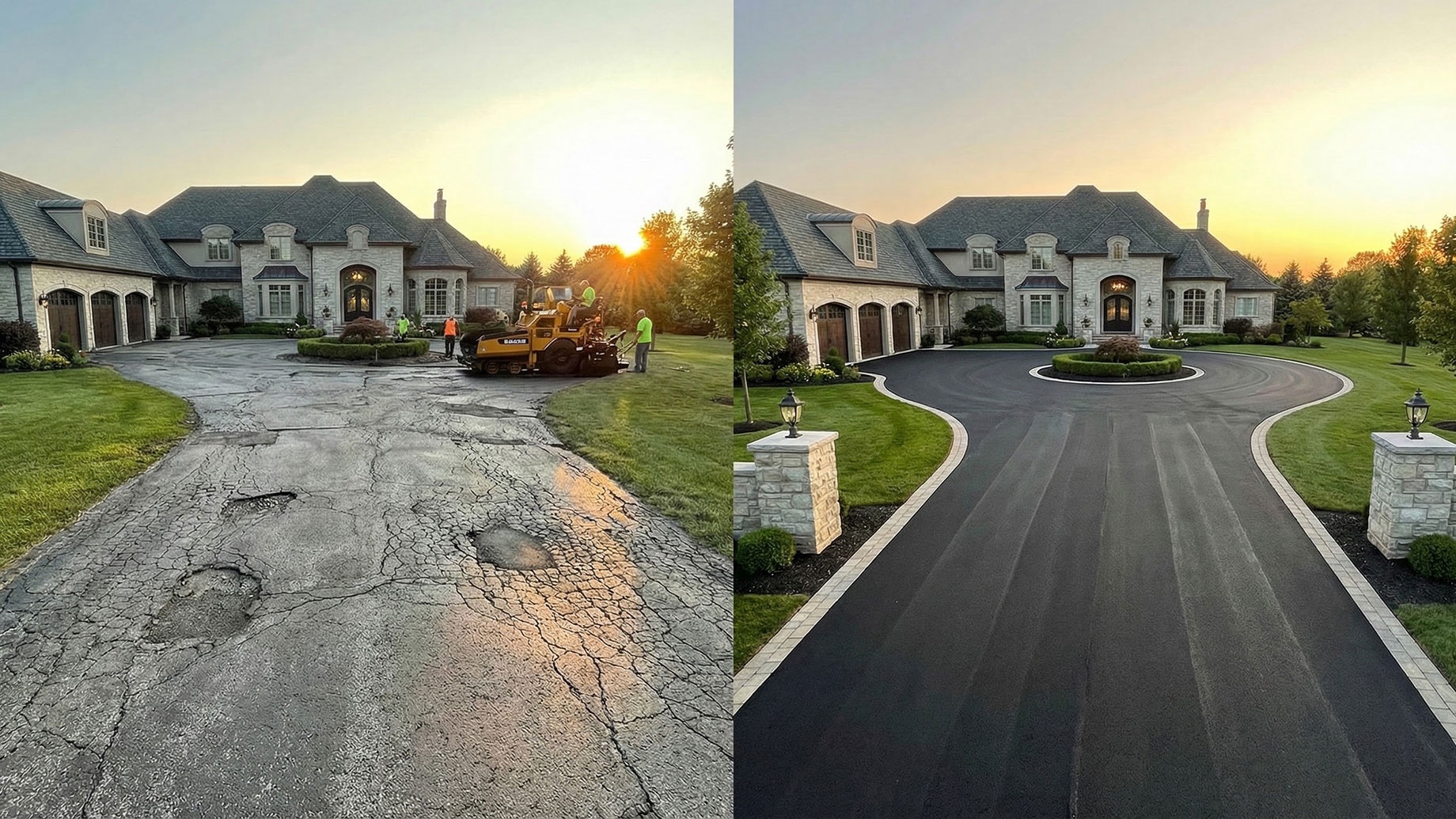
How Sealing and Crack Filling Break the Cycle
The logic is straightforward: if water cannot enter the asphalt, it cannot freeze inside it. Sealing and crack filling work together to close every water entry point on the surface.
Crack filling targets the openings water uses to reach the interior. A rubberised compound — or for wider cracks, a heated self-levelling hot-rubber product — is worked into each crack and bonds to both walls. Critically, it stays flexible through temperature swings rather than becoming brittle and cracking itself in the next cold snap.
Sealcoat creates a flexible, waterproof membrane across the entire surface. It seals the micro-pores in the asphalt itself, repels water, slows UV oxidation of the bitumen binder, and resists salt penetration. A well-applied commercial-grade sealcoat lasts 2–4 years in a Gatineau–Ottawa winter, depending on traffic and drainage.
Together, they turn a permeable surface back into a water-resistant one — breaking the freeze-thaw cycle at its starting point.
The Best Time to Protect Your Driveway
The ideal window is before winter arrives — which in practical terms means late May through September for Gatineau and Ottawa homeowners. Sealcoat needs temperatures above 10°C and a 24–48 hour dry window after application to cure properly.
- Late May to June: excellent conditions. Ground is dry after snowmelt and temperatures are stable.
- July to August: ideal curing conditions. Book early — the schedule fills quickly mid-summer.
- September: still viable for the first half of the month. Getting sealed before Canadian Thanksgiving gives the coat a full cure before the first hard frost.
- October onward: too risky. Night temperatures in Gatineau regularly drop below the cure threshold by Thanksgiving, and an under-cured seal can actually trap moisture rather than repel it.
If you are reading this in spring and notice fresh cracking from last winter, that is your signal: address it now, before the next freeze season locks in more damage.
How Drivewave Helps — One Price, Everything Included
We price by driveway size at roughly $0.70 per square foot, with a $200 minimum. Driveways over 1,000 sq ft get a custom quote. That one price includes everything: pressure washing, oil and stain treatment, crack filling (including hot-rubber treatment for wide cracks), and two-coat commercial-grade sealcoat application. There is no per-service menu and no surprise add-ons when we arrive.
| Driveway size | Typical sq. footage | Approximate price |
|---|---|---|
| 1-car driveway | 200–350 sq ft | ~$200–$245 |
| 2-car driveway | 400–650 sq ft | ~$280–$455 |
| 3-car driveway | 700–900 sq ft | ~$490–$630 |
| Large / estate | 1,000+ sq ft | Custom quote |
The on-site quote is always free and with no obligation. Use our instant estimate tool for a quick ballpark, or book a free on-site quote and we will measure, assess the crack situation, and give you a firm price on the spot. Most jobs are completed in a single visit — you can walk on the driveway by evening and put cars back the following day.